Articles
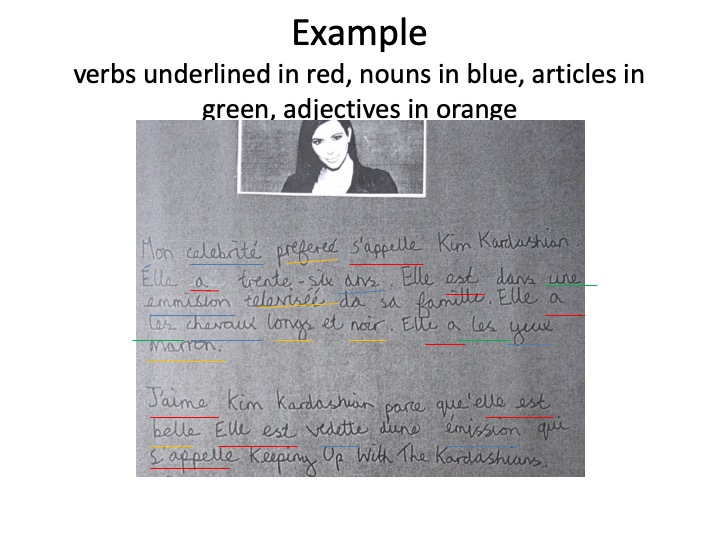
1a) Use gender and articles (singular and plural), showing knowledge of the patterns learnt, but still frequent errors and omissions in independent use.
Adjectives
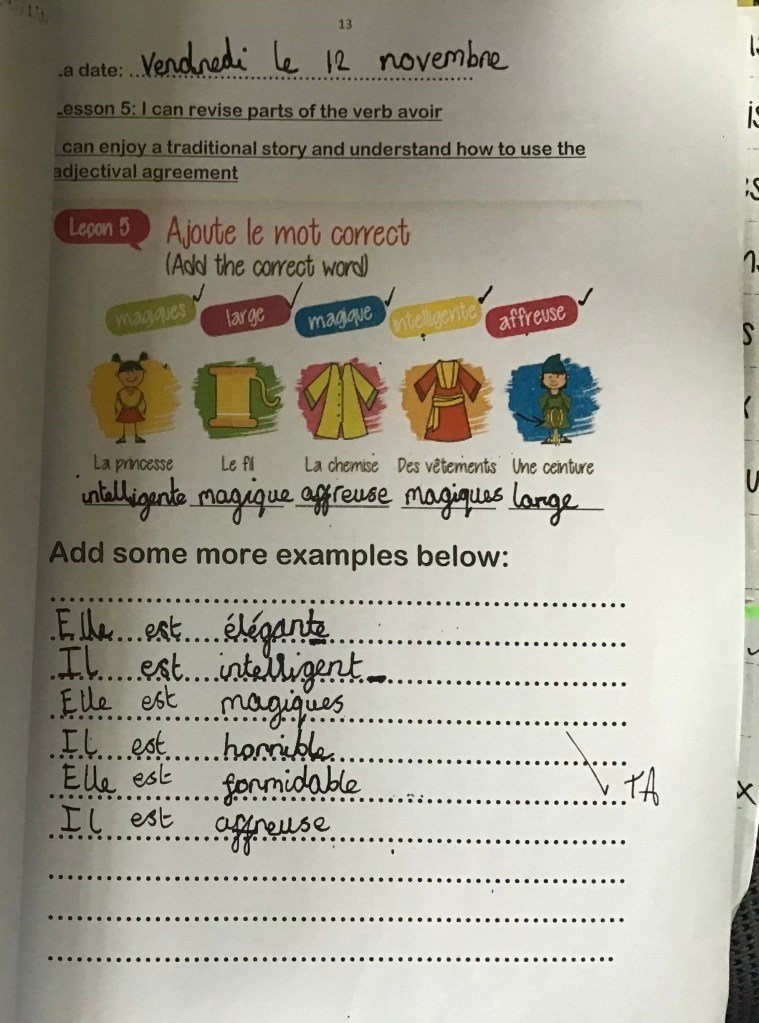
2a) Agree adjectives for number and gender after ils/elles
2b) Understand word order and agreements: nouns, adjectives, verbs
Verbs
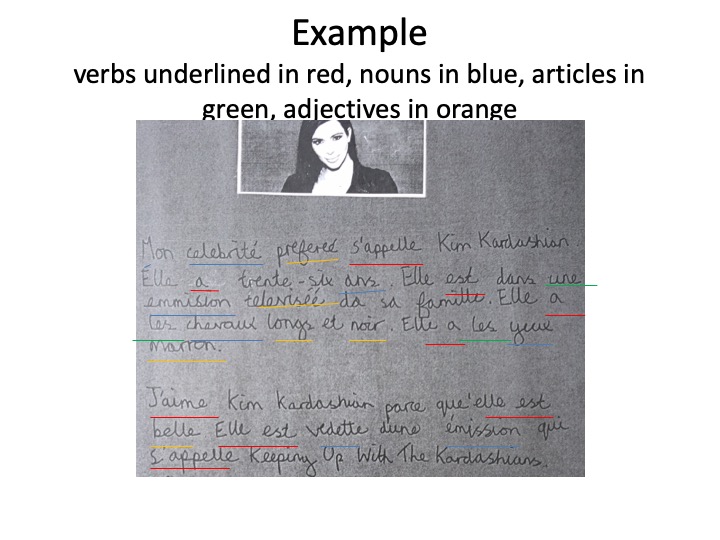
3a) Use the full conjugation of the verbs être and avoir in several different contexts, still with some errors.
3b) Use the perfect tense with auxiliary avoir and or être with regular verbs in the 1st person.
3c) Imperfect phrases;e.g. c’était., j’étais, j’avais
3d) Introduction to reflexive verbs in the 1st person relating to daily routine.
3e) Modal verb; je peux + infinitive (I can …)
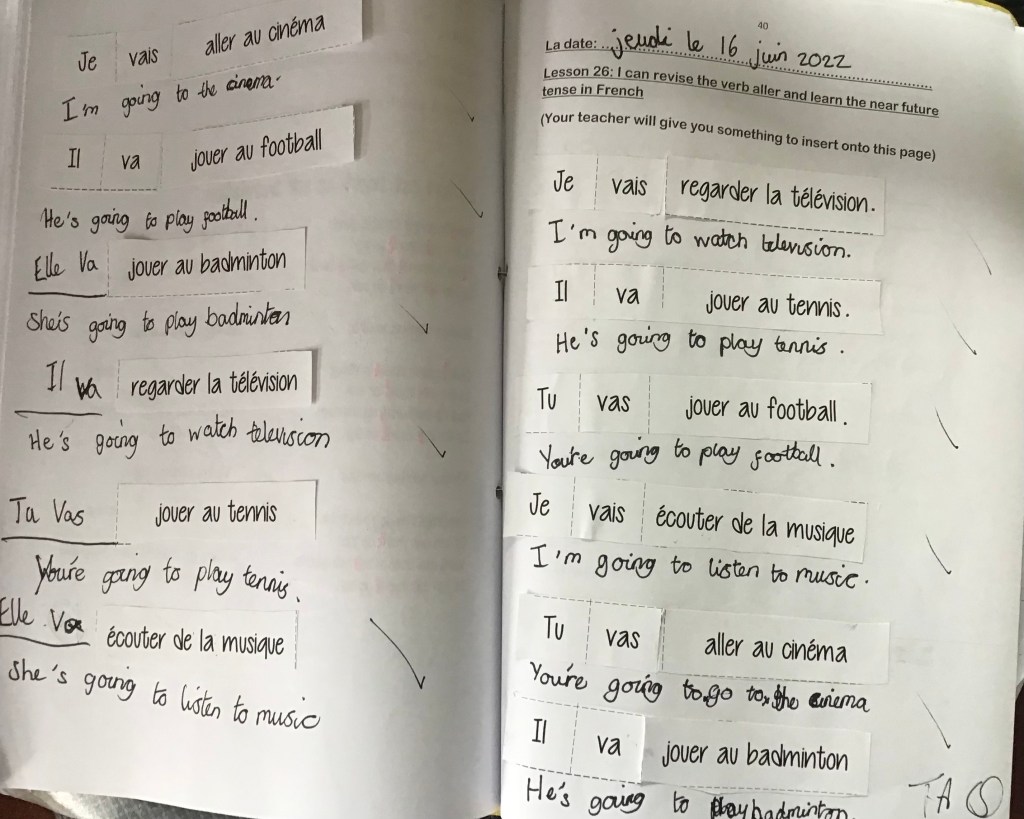
3f) Use near future with aller + infinitive using various subject pronouns
3g) Focus on verb + partitive
3h) Use the proper future in the 3rd person singular to add reasons.
Negatives
4a) Use of different negative structures (ne… pas, ne… plus, ne… que, ne…rien) with variety of high frequency verbs.
Prepositions
4b) Prepositions of direction relating to location in towns/rooms (près de, loin de, à guache, à droite)
Adverbs
5a) Adverbs of time, sequence) (analogue times), (après, ensuite, le soir)
More Complex Language
6a) Use comparative language (plus/ moins que and mieux/pire).
6b) Use subordinating connectives si (if) and some may be able to use que (which).
6c) Form question words.
 PERLE
PERLE 